
Wednesday, December 26, 2012
A brief note on New Year's Resolutions
Now that Christmas is over it is time for many of us to shift our focus towards those personal promises that almost never stick past the first two weeks of the fresh calendar year. The holiday season, as great as it can be, often times drives one to the acceptance of weeks worth of gluttonous eating and putting off projects; lazing about on snowy days easily dismissing any productivity with an "eh...it's the holidays" malaise. The culmination of the "most wonderful time of the year" is the epic quest for personal betterment in the form of the New Year's resolution. Now, I am by no means against becoming a better human, but these resolutions almost never work. I don't have statistics to back up this claim, however I can attest to years of personal experience along other testimonies from numerous acquaintances - so you'll just have to trust me on this one. Last year I developed and tested a radical idea that will offer the chance to fool yourself into thinking your resolution is simply something you've been doing all along. Here's the trick (in two parts): 1. Don't wait until January 1st...make the change today. 2. Don't tell anyone what your resolution is. If you know what it is you would like to resolve, why wait the extra week? After all, going back to work or school after the holiday recess can be hard enough without remembering something mundane like abstaining from eating potato chips. As for part two of the ruse, the harsh reality is nobody will care if you stick to your resolution so just keep it to yourself. This also will reduce the stress of public failure and focus accountability solely on you (after all you are doing this for yourself right?). So before that ball drops of New Year's eve, throw away those chips, start filling up the journal that's been sitting on your bookshelf all last year, draw - and paint - new things, or learn a new computer program. Whatever it may be, make that promise to yourself today...and Happy New Year!

Wednesday, December 5, 2012
Holiday Shopping for the Creative Professional [Part II: Presents!!!]
Now that we have a brief background of what not to get for so-and-so this holiday season, let's progress into some simple, and often overlooked, ideas that your lucky recipient will be more than thankful to receive this year:
Although most bookstores offer a limited art section relative to other subjects (e.g., religious fiction, science fiction, teen fiction) there is no shortage of books on various subjects, spanning the techniques, topics and people surrounding the profession. While I personally prefer biographies and historical books, a nice book on color theory or typography will also peak my interest. There are also many great compendiums of posters, graphic design and museum collections that you would think may be destined for the proverbial coffee table. However, I can guarantee that if you know your artist, you can pick one of these treasuries that they will absolutely devour!
More expensive options, in addition to the aforementioned compendiums, are computer books. Creative professionals have to be educated continually on the newest software and programming languages in order to develop relevant and functional design solutions in today's fast-paced and competitive market. Getting a book on HTML 5 or Adobe Creative Suite 6 will not only be much appreciated, it will also let your giftee know that you understand, support and encourage the progression of their career.
If you want to go another direction in regards to books, maybe take a look at the business section. While most of this section is geared towards corporate business and investing, there a few books on entrepreneurial life peppered throughout (helpful hint: try to find the Starting a Business or Marketing sub-sections). Another idea that might be more practical is a book on legal issues and taxes in the small business arena. A note of caution: Creativity is a buzz word that has been trending in the corporate business world lately in reaction to the economic downturn. In other words, many companies are being forced to find creative ways to keep their business running in tough times and not necessarily utilizing more creative professionals or implementing the artistic process (besides drawing on napkins). Just make sure to do your research before you purchase...or get gift receipts!


Regardless of what you decide to buy as gifts this holiday season, just remember to have fun. You are obviously making the choice to give a gift because you care about whoever it is you're buying the gift for. With the intensified crowds everywhere it can be highly stressful just running to the grocery store to pick up the necessities let alone doing the extracurriculars in retail hell. Hopefully some of these tips will see you through the tough times and remember, if you don't like any of these ideas you can always fall back on berets and black turtlenecks! Once again, best of luck and Happy Holidays!!!
 Books:
Although most bookstores offer a limited art section relative to other subjects (e.g., religious fiction, science fiction, teen fiction) there is no shortage of books on various subjects, spanning the techniques, topics and people surrounding the profession. While I personally prefer biographies and historical books, a nice book on color theory or typography will also peak my interest. There are also many great compendiums of posters, graphic design and museum collections that you would think may be destined for the proverbial coffee table. However, I can guarantee that if you know your artist, you can pick one of these treasuries that they will absolutely devour! 
More expensive options, in addition to the aforementioned compendiums, are computer books. Creative professionals have to be educated continually on the newest software and programming languages in order to develop relevant and functional design solutions in today's fast-paced and competitive market. Getting a book on HTML 5 or Adobe Creative Suite 6 will not only be much appreciated, it will also let your giftee know that you understand, support and encourage the progression of their career.
If you want to go another direction in regards to books, maybe take a look at the business section. While most of this section is geared towards corporate business and investing, there a few books on entrepreneurial life peppered throughout (helpful hint: try to find the Starting a Business or Marketing sub-sections). Another idea that might be more practical is a book on legal issues and taxes in the small business arena. A note of caution: Creativity is a buzz word that has been trending in the corporate business world lately in reaction to the economic downturn. In other words, many companies are being forced to find creative ways to keep their business running in tough times and not necessarily utilizing more creative professionals or implementing the artistic process (besides drawing on napkins). Just make sure to do your research before you purchase...or get gift receipts!
Magazines:
While these printed publications are still around, they make a great gift idea. Take a trip though the the periodicals at your local news stand, find some exciting magazines or maybe purchase a year long subscription to a quarterly art rag. A single issue fits nicely into a stocking, lightly rolled up around that care package of pens and highlighters from the previous post! Art and design magazines aside, current world events are also very important for the artist to stay educated on. Thus, a magazine like Time (a weekly publication) will surely keep your creative professional up to date on current trends as well as offer a worldly perspective that should theoretically transcend the social commentary of their visual work. This is also a great opportunity to break the rules a bit and "judge a book by it's cover." If you come across a magazine with an eye catching cover illustration, it might be worth your while to get it as a gift. Artists tend to appreciate quality illustrations in print form as we are naturally respectful fans of our profession (I can personally testify to collecting magazines that include artwork by some of my favorite illustrators).
Entry fees:
Some very reputable publications hold annual art contests with an open call for entries. The artist, if he or she would like to submit their work, simply pays the entry fee and enters their work. Payment of an entry fee to a competition would make very generous gift. I should warn, however, that not all contests are created equal. Keep your ears open to pick up any hints regarding contests or magazines your artist might be interested in. A read though of the contest's rules and conditions will also give good indication of whether or not it is a legit showcase where the artist's rights will be protected and ownership of his or her work will remain proprietary. If you're not comfortable with choosing a contest, an extremely generous gift this year would be the payment of membership fees of an artists union (e.g., Graphic Artists Guild, Society of Illustrators, Freelancers Union, etc.).Gift Cards:
I know the general attitude towards gift cards is that they are as impersonal as it gets as far as gift giving goes. Personally, I love them and I love getting them. As mentioned in the previous post (see Part I: The Don'ts), the tricky part about shopping for a creative person is the fact that they are particular about their tools and materials. Gift cards are an easy way to avoid buying something that won't be used, and ultimately won't be appreciated. And gift cards don't have to be limited to art suppliers. Hardware stores (Lowe's or Home Depot) are great places to pick up materials on the cheap and a gift card can go a long way at one of these stores.Commission a Painting:
The best gift you can give to an artist is the opportunity to work, so why not hire them to do that painting you've always wanted?
Regardless of what you decide to buy as gifts this holiday season, just remember to have fun. You are obviously making the choice to give a gift because you care about whoever it is you're buying the gift for. With the intensified crowds everywhere it can be highly stressful just running to the grocery store to pick up the necessities let alone doing the extracurriculars in retail hell. Hopefully some of these tips will see you through the tough times and remember, if you don't like any of these ideas you can always fall back on berets and black turtlenecks! Once again, best of luck and Happy Holidays!!!
Sunday, December 2, 2012
Holiday Shopping for the Creative Professional [Part I: The Don'ts]
 |
| See below {No. 2} |
1. Art supplies:
As an artist myself, I can tell you that we can be a particular bunch when it comes to materials. That being said, the supplies we choose to use come from years of exhaustive experimenting with the many options available. The endless exchange between learning to manipulate mediums and developing personal style (i.e. finding your "voice") is an organic process not to be interrupted by the introduction of a new or foreign method. This is not to say an artist shouldn't experiment with new mediums (in fact it's a necessity and certainty), but rather that the artist, and only the artist, will know when he or she is ready to make the endeavor. Not to mention if you have ever set foot in an art supplies store, and I don't mean Michael's, you may find yourself overwhelmed with the bombardment of various brands of the same products, multiple questions regarding multiple items, and the cold unwelcoming ambiance of a real utilitarian art repository (staff included). So save yourself some stress, and unless you have a very specific list from the artist you're buying gifts for, stay away from the art supplies...or just buy a gift card (more on this later).
2. Motivation (by book or block):
There are many products out there that offer inspiring nuggets of wisdom. There are even books of motivation specifically targeting the artist. The newest trend that's catching fire (see photo above) is an influx of quotations screen printed onto painted blocks of wood. The problem with quotes is that they are most often ages old (hence wisdom), usually taken out of context (misinterpreted), which leads to misquotation or transformation from their original meaning (thus, invalid). Personal artistic drive does not stem from a quipster like Oscar Wilde (or that wily and equivocal Anonymous) nor, furthermore, from a tome of fallacious quotations or a block of wood invading the aesthetics of any artistic workspace. If only motivational quotes provided some practical advice like "Paint some words of wisdom on wood; fill your pockets with cabbage." Now don't get me wrong, there are times when quotations are appropriate (key note speeches, graduation ceremonies, etc.) and I have much respect for their authors and the fact that their wisdom can still be found relevant sometimes hundreds of years posthumously. I just don't condone supporting the racket that has become the quotation industry. Whether it's books, blocks of wood, coffee mugs, tea cups, posters, planners, calendars, bobble-heads, tee shirts, sweatshirts, stadiums, ashtrays, locker room walls, business cards, enlightened energy drinks, sandy beaches, bulletin boards, chalkboards, dry erase boards, skate boards (did I mention blocks of wood?), desktop wall papers, toilet paper (this might actually be a good idea), bumper stickers, hats, plaques, or polished rocks, I guess it's just not my thing. Ironically what I'm really trying to say can be easily packaged as a quotation:
"While influence is ubiquitously strewn about, the real deal, motivation, must come from within." - me {ca. 2012}
And you can put that on a block of wood (just give me credit).
3. A quick note on stocking stuffers:
Here's a chance to put some prior information to use. Try not to fill your artist's stocking with art supplies this holiday season. I know it can be tempting seeing that many tools (pencils, pens, markers, 2 oz. tubes of paint, paintbrushes, pocket sized sketchbooks) will fit nicely with room to spare for other odds and ends. If this is something you do want to include in the sock-o-booty, might I suggest poking around the artist's studio a bit to find out what brands they tend to use. For example, I like to use my trusty Dixon Ticonderoga No.2 - HB pencils when drawing. So, if I were to find a pack of those in my stocking, it would obviously not be a bad thing. Another idea that is often overlooked by people outside of the creative industry (yes, even your closest friends and relatives) is that you are running a business and this means you need business things at your disposal. A stocking filled with highlighters, post-it notes, batteries, USB jump drives, paper clips and staples can be more appreciated than one may think.
Best of luck and Happy Holidays!
Stay tuned for Holiday Shopping for the Creative Professional Part II...
Wednesday, November 14, 2012
Save the Brushes!
We've all had one...the paintbrush that has been a part of the crew for years; the brush that fell into the role of the versatile "go-to" for most situations; the brush that was apathetically set aside time after time, neglected during routine cleanings until the bristles became randomly stuck together by mediums and paints - and sometimes coffee. More often than not, this is a good indication of when to file this particular paintbrush in the garbage can (or give it a viking funeral) but it may still have a purpose...a renaissance, if one will.
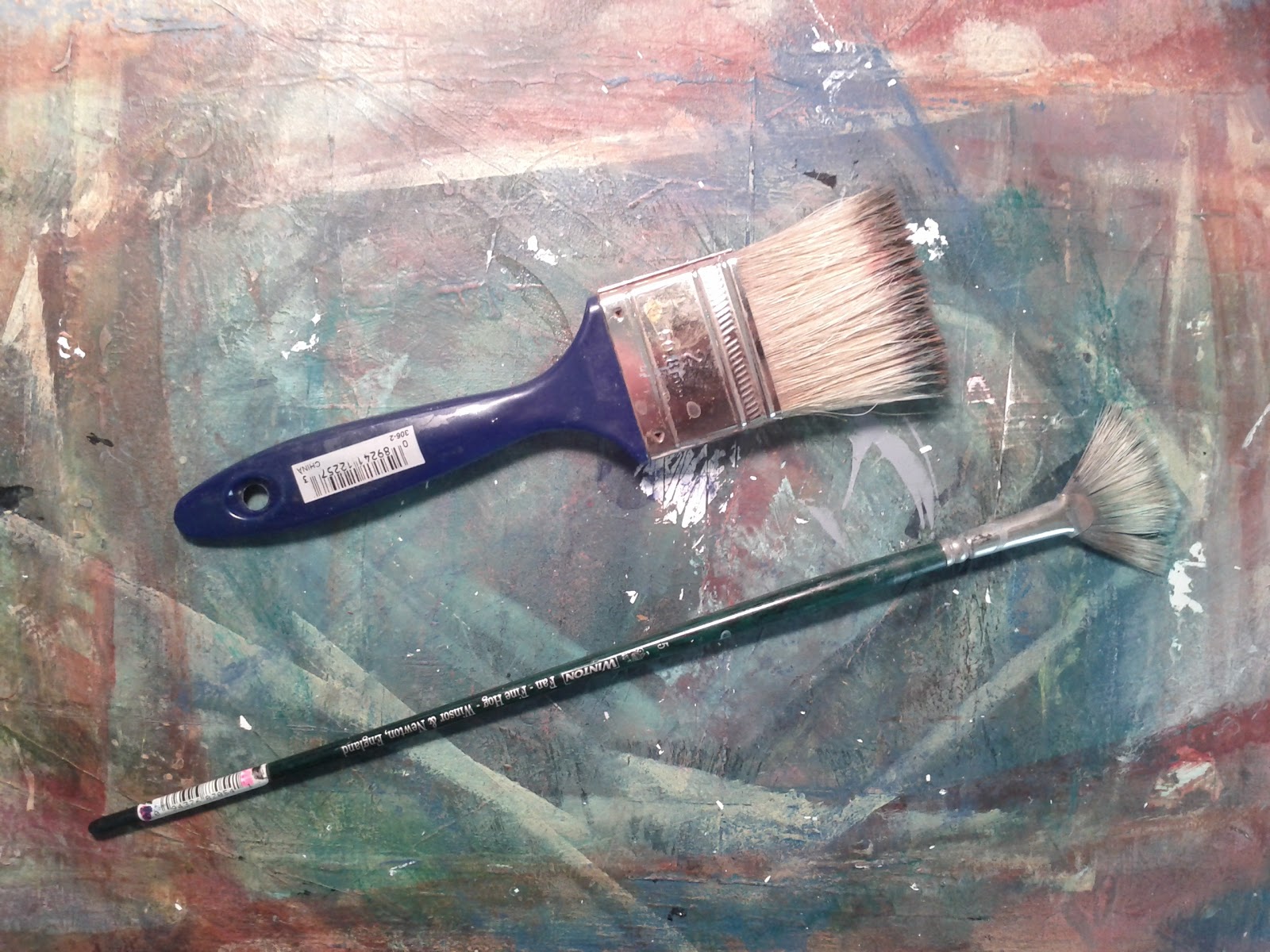
Today I will be talking briefly on making some unique textures with the exciting random patterns of your very own mutilated paintbrushes. Above is a picture of a couple of mine that I continue to use - notice the paint remnants on the tip. This was not the original fate I had in mind for these two, but I forgot to wash once...and then again...and the more I used them, the more I began to get some unique artifacts popping up in my backgrounds. Just as a side note, by no means do I suggest deliberately ruining your brushes to manufacture textures, but if you want to buy some cheap ones to give it a try, go for it. However,the true spirit of this technique is meant to be purely incidental so if you don't have a brush like this yet, just wait a while because it will happen eventually.
Basically after the brush is "destroyed", either use it to paint with directly or dry brush. Just push the paint around with it and see what happens. After the layer is dried you can sand down the texture to accentuate some of the artifacts that occur.


This process really hits its stride when you start building layers, sanding down the previous one before applying a fresh random coat. Not only will the paint become richer in appearance, the random control of the exaggerated brush strokes will begin to "battle" with each other, resulting in organic, painterly, and idiosyncratic backgrounds.
 |
| Wilson! I'm sorry Wilson...Wilson...I'm...sorry... |
Today I will be talking briefly on making some unique textures with the exciting random patterns of your very own mutilated paintbrushes. Above is a picture of a couple of mine that I continue to use - notice the paint remnants on the tip. This was not the original fate I had in mind for these two, but I forgot to wash once...and then again...and the more I used them, the more I began to get some unique artifacts popping up in my backgrounds. Just as a side note, by no means do I suggest deliberately ruining your brushes to manufacture textures, but if you want to buy some cheap ones to give it a try, go for it. However,the true spirit of this technique is meant to be purely incidental so if you don't have a brush like this yet, just wait a while because it will happen eventually.
Basically after the brush is "destroyed", either use it to paint with directly or dry brush. Just push the paint around with it and see what happens. After the layer is dried you can sand down the texture to accentuate some of the artifacts that occur.


This process really hits its stride when you start building layers, sanding down the previous one before applying a fresh random coat. Not only will the paint become richer in appearance, the random control of the exaggerated brush strokes will begin to "battle" with each other, resulting in organic, painterly, and idiosyncratic backgrounds.
Saturday, October 27, 2012
Save the Coffee Cans!
Good day creatives! Today I have a couple quick tips I recently had the chance to apply to my workflow that might be useful to yours as well. All you need is an empty coffee can and a rubber band (if you don't drink coffee, any spent 30 oz. container will work just fine):
First make sure the coffee can is rinsed out and cleared of all stray grains (nobody wants grounds contaminating their paint) and set aside the lids for later. Once fully cleaned, the cans are ready to mix some paint:

After you get your paint mixed, simply wrap a rubber band around the length of the can so that it spans the open top. The lid can still be applied to preserve your paint for later:

The idea with the rubber band is to unload the brush of excess paint before using it to apply paint on the painting surface:
One last note: If you're using acrylic paint, hang a damp paper towel on the rubber band before replacing the lid. This should keep the moisture in the can at an optimum level to save even more paint in the long run.
First make sure the coffee can is rinsed out and cleared of all stray grains (nobody wants grounds contaminating their paint) and set aside the lids for later. Once fully cleaned, the cans are ready to mix some paint:

After you get your paint mixed, simply wrap a rubber band around the length of the can so that it spans the open top. The lid can still be applied to preserve your paint for later:

The idea with the rubber band is to unload the brush of excess paint before using it to apply paint on the painting surface:
 |
| Load up the brush with paint. |
 | ||
| Gently slide brush across the rubber band. |
 |
| Preserve extra paint for later use. |
 |
| Money in the bank! |
Monday, October 15, 2012
Editorial illustration and election season (the art of being impartial)
 |
| M.R. - © 2012 Michael Zabel Illustration |
 |
| B.O. - © 2012 Michael Zabel Illustration |
Sunday, September 30, 2012
The Art of the Economic Draftsman: Spray Fixative
Howdy folks, and welcome to another installment of the Art of the Economic Draftsman. This week we take a quick look at workable spray fixative and ultimately, of course, saving some precious dollars and cents to roll into other areas of your illustration business.
Spray fixatives range in price like most art supplies and the price you pay really depends on how much you rely on it for your own personal process. I should also point out that there are some fixatives that are specifically better for certain mediums (see Sennelier Delacroix fixative for oil pastels). It's always a good idea to try out some different brands and take note of which product works best for your style and what helps to produce professional quality artwork.
 The spray fixative I normally use is the Utrecht® Workable Fixative. This 11 oz. can has a list price of $7.69 but it is more often than not on sale for around 5 dollars on the Utrecht website (my normal supplier). This fixative is one that I trust and it gets the job done for what I use it for - usually to hold down a charcoal or graphite drawing in which I plan to apply a wet media over top of. This fixative is also great for an "onion skinning" drafting style in which an image is edited and re-edited with layers of neutral acrylic washes over each drawing layer (hence, "onion skinning"). The acrylic paint, being plastic, can get a little tough to draw on with a plain old Dixon Ticonderoga No. 2 pencil, so a light application of spray fixative will generally go a long way, creating a nice toothed layer to work on. A comparable product, in regards to performance, is the Krylon® 1306 workable fixative which retails at about 7 bucks online for an 11 oz. can. While one can see that these are two reasonably priced items, there is still a way that money can be saved...especially if your artistic process, like mine, requires a minimal use of spray fixative.
Last week I was waking up from a relatively good night of sleep while my fiancée, Marji, was getting ready for work. I shuffled past the bathroom, said good morning to Marj (as always), and carefully descended down the shadowy stairs to the kitchen where I would brew up some fresh beans. As the coffee pot gurgled into its own waking life, I slumped back up the stairs to turn on my computer and effectively start my work day when I heard a curious sound. Curious...yes...but only because I have heard it almost every weekday for years upon years. The brief escape of compressed air and hair product resonated down the hall in the early morning calm; Marji, applying a quick spritz of Suave® Extreme Hold Hairspray in an effort to tame her misbehaving curls. Awaiting the invitation of my computer's desktop, the clean slate of my morning brain made a connection of audio signals between the application of hairspray and the application of spray fixative. Genuinely interested, and ignorant, my questions about hairspray were seemingly endless.
Does that stuff hold pretty well?
Yep! As long as it's not humid.
How big is that bottle?
Ummm...(looks at the bottle)...11 ounces.
What's the biggest bottle I can get?
Costco sells huge ones.
Is there an unscented version?
Yes...
How much does that cost?
The last question had the most surprising of answers: "Oh...about two bucks at Walgreens."
So, $2.00 and some change later (you didn't think I would actually use up Marji's hairspray when she went to work did you?), I was experimenting with the integrity of Suave® Unscented Extreme Hold Hairspray as an artistic medium. For my own personal process, the hairspray does a great job and thanks to my lovely fiancée, I now have a cheap option for art supplies and a hair dryer to speed up my painting process!

Spray fixatives range in price like most art supplies and the price you pay really depends on how much you rely on it for your own personal process. I should also point out that there are some fixatives that are specifically better for certain mediums (see Sennelier Delacroix fixative for oil pastels). It's always a good idea to try out some different brands and take note of which product works best for your style and what helps to produce professional quality artwork.

Last week I was waking up from a relatively good night of sleep while my fiancée, Marji, was getting ready for work. I shuffled past the bathroom, said good morning to Marj (as always), and carefully descended down the shadowy stairs to the kitchen where I would brew up some fresh beans. As the coffee pot gurgled into its own waking life, I slumped back up the stairs to turn on my computer and effectively start my work day when I heard a curious sound. Curious...yes...but only because I have heard it almost every weekday for years upon years. The brief escape of compressed air and hair product resonated down the hall in the early morning calm; Marji, applying a quick spritz of Suave® Extreme Hold Hairspray in an effort to tame her misbehaving curls. Awaiting the invitation of my computer's desktop, the clean slate of my morning brain made a connection of audio signals between the application of hairspray and the application of spray fixative. Genuinely interested, and ignorant, my questions about hairspray were seemingly endless.
Does that stuff hold pretty well?
Yep! As long as it's not humid.
How big is that bottle?
Ummm...(looks at the bottle)...11 ounces.
What's the biggest bottle I can get?
Costco sells huge ones.
Is there an unscented version?
Yes...
How much does that cost?
The last question had the most surprising of answers: "Oh...about two bucks at Walgreens."
So, $2.00 and some change later (you didn't think I would actually use up Marji's hairspray when she went to work did you?), I was experimenting with the integrity of Suave® Unscented Extreme Hold Hairspray as an artistic medium. For my own personal process, the hairspray does a great job and thanks to my lovely fiancée, I now have a cheap option for art supplies and a hair dryer to speed up my painting process!

Subscribe to:
Posts (Atom)